Saturday, 11 November 2017

Road to Rajasthan


             Day 15.

              Our last day started with a visit to the City Palace which was built in 1725 by Maharana Udai Sing and overlooks Lake Pichola.

               The Palace comprises of 11 palaces including the Dilkhush Mahal,Sheesh Mahal, Moti Mahal and the Palace of Lord Krishna,

              all of which are ornately decorated. The City Palace also houses the worlds largest private collections of crystals.

              Then it was a cruise on Lake Pichola which is a 4 Km long Lake is fringed with hills palaces, havelis, ghats and temples.

              We also cruise past the Lake Palace formally known as Jag Niwasbuilt between 1734 and 1751. It was once a Royal summer retreat

               And is now one of the worlds greatest hotels. It is also a popular location for film shoots such as James Bonds Octopussy.

               Next it was Fateh Sagar Lake an artificial lake built in 1678 embellished with 3 islands one of which houses a garden caf’e.

              We then had lunch at one of the best restaurants we have visited The Courtyard.

              It was then to Sahelion Ki Bari gardens a 18th- century garden retreat in the north of the city built for the Queen of Udaipur 

              who’s dowry included 48 maids.

               Our next stop was the folk museum and housing a remarkable collection of Rajasthani fork art.

              The last stop was Mewar Art Gallery where they do full size paintings in miniature.

              After a freshen up it was to restaurant 1559 for our farewell dinner.

              Hope you enjoyed our journey on the Road to Rajasthan tomorrow starts another road journey.


View from our hotel balcony in Udaipur 

On Lake Pichola and Lake Palace ( Jag Nina )

The West wall of City Palace 

The main gate of the City Palace 
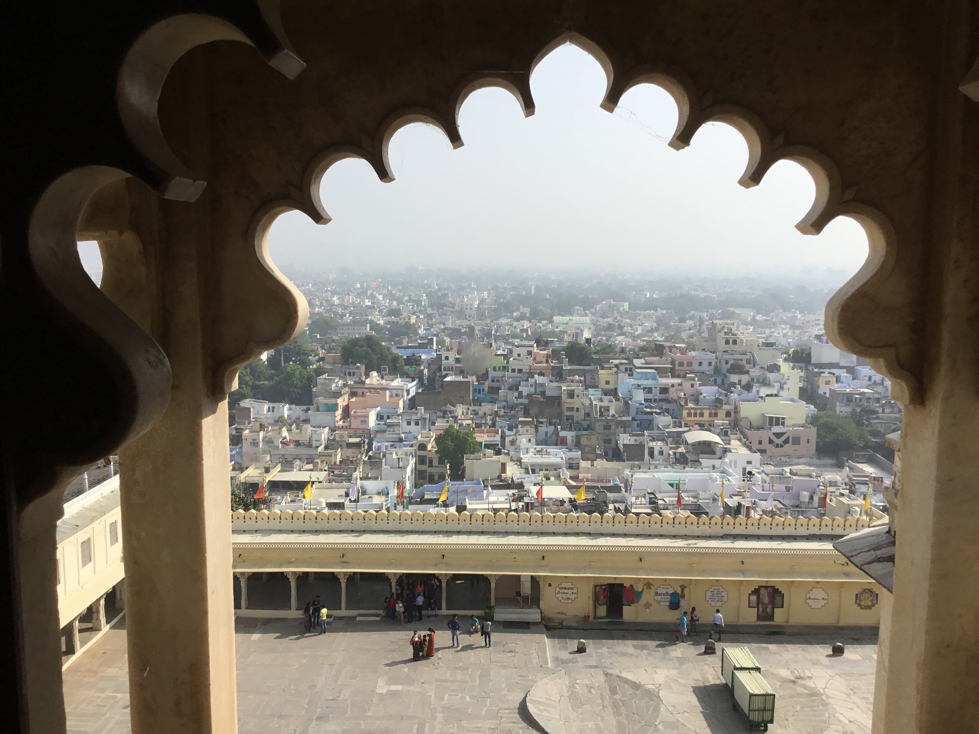

View of Udaipur from the City Palace 

The oldest tree on one of the three Islands in Fateh Sagar Lake.

Garden caf’e on Fateh Sagar Lake 


Val at the fountain in Sahelion Ki Bari Gardens 

Love

 Len and Val

Friday, 10 November 2017

Road to Rajasthan


            Day 14       

            Left the Hotels at 0800 for a 30 minuet drive to a weaving outlet for a two hour stop, departed at 1030 for our drive to Udiapur stopping 
          
            For lunch at 1315 of what we thought was a bad road . After we headed to Jain temple complex built in the 15th century and located 

            In Ranakpur in the  Aravalli valley. The main temple in the complex is the Chaumukha (four - faced) Temple built in 1439 

             It’s 29 Halls are supported   by 1444 pillars of which no two are alike.Also visit the Surya Temple, dedicated to Surya the Sun God, 

              and other Jain temples.

             Then our final leg of the of the drive was over the worst road Val and I have ever been a to make it worse the drivers apart from 

              our driver be it motor bike, car, truck, or school bus are the worst without any doubt the last section of 110 Km took 2 hour 15 Min

              The origins of Udaipur are based on a legend,which tells of a holly sage that Maharaja Udai Singh encountered while hunting in the 

              foothills of the Aravalli Range in Mewar. The sage told the King to build a Palace in that exact spot and it would be well protected 

             and so with this advice, Maharaja Udai Singh built his residence there. At the time Chittorgarh was the capital of Mewar State,

              however in 1568 Chittorgarh was attacked by the Mughal emperor Akbar, and so Maharaja Udai Singh moved the capital to Udaipur.

              Today the city Palace of Udaipur is still home to Maharaja Udai Singh’s descendants who remain rulers of this independent state.

              We will be able to tell if the Maharaja is in residence by the flag hanging from the palace wall.


One of the villages between Ranakpur and Udaipur         


Small village same area 

Farm landin the area.

A work on the side of the road 


Another village.

Love 
Len and Val 


Thursday, 9 November 2017

Road to Rajasthan


             Day 13.

              Today was a full day starting at 0830 and on the way we came across a group of pilgrims who were returning back to their home villages 

                after a 4,000 Km pilgrimage  to they holly place, where some of the locals were feeding some of the local cattle by the side of the road that

                on one owns they just wander around and feed on the side of the road. 

                 As we were there a group of nuns of the Jain Sect came past we visit ther Temple tomorrow, it was then onto a local family of Shwetamber

                 People a sect who are true vegetarians they only eat vegetables that grow above the ground.

                 Our next stop was Gouda Bishnoiyan a National Park where there a large flock of Kurja ( Demoiselle  Crane) at the waterhole.

                 Next was mandatory carpet weaving place follow by something new a pottery place.

                After lunch it wa to the Umaid Bhagwan Palace one of the great palaces of India and is know a museum.

                Next was the stop at the Mehrangarh Fort raised 120 mts above the city’s skyline with its latticed windows known as Jarokhas,

               The chambers of Moti Mahal, Phool Mahal,Sheesh Mahal the Sileh Khana and the Daulat Khanaare the splendour and glamour of a bygone era.

               To finished of the day it was a auto- rickshaw ( tuc tuc ) ride a local vegetable and spice market.

Val feeding the local roadside bull.

The farmer.

The wife.


Some of the road traffic.


The Kurja ( Demoiselle Crane) at the waterhole 

Carpet Weaver 


Len 

Val at Umaid Bhagwan Palace 

 
Mehrangarh Fort.

Val and the sunset at Merrangrah Fort.

Vegetables in Sardar Market 

Spices that can you can buy at the market 


One of the locals visiting the market 

Love 
Len an Val

Wednesday, 8 November 2017

Road to Rajasthan


            Day 12.

             We had a full day on the road traveling from Jaipur to Jodhpur a distance of 338 Km which is the second biggest City in Rajasthan 

              and is located at the entrance to the Thar Desertin the region called Marwar.The old city founded in 1459 is surrounded by a 10 Km long wall

              and situated on a 125 high hill. The massive Mehrangarh Fort overlooks the city and the red sandstone palaces with in the Fort form one of the 

              most impressive complexes in Rajasthan.

               We had our lunch stop at Ajmera small village which is know for its marble.

               Getting into Jodhpur at 1715 booked into our hotel and had dinner.

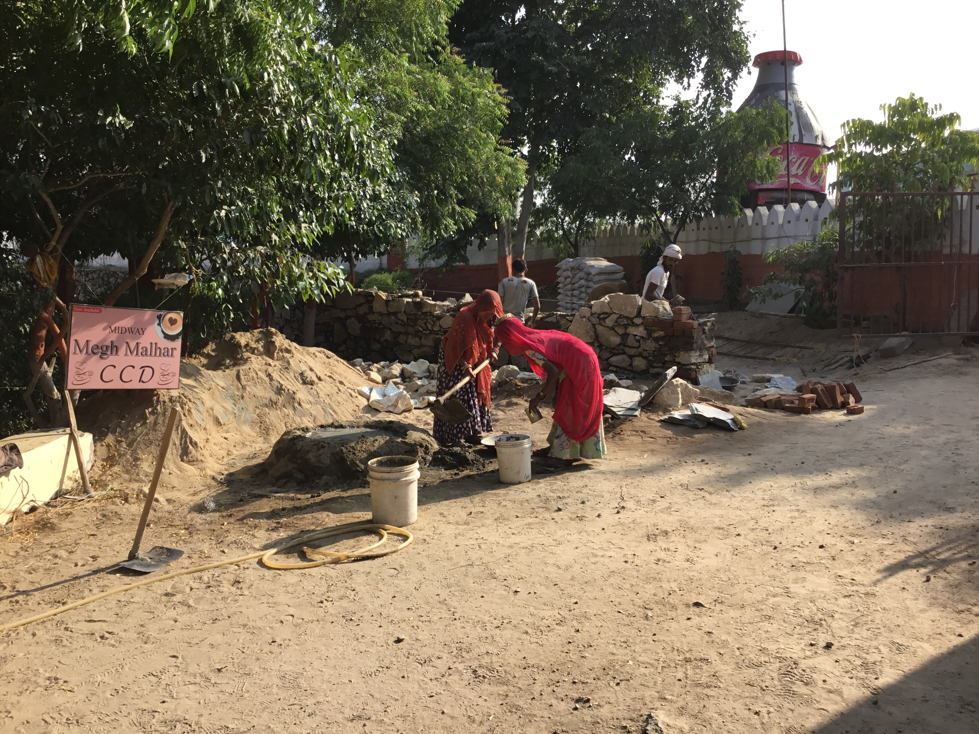
Building a new fence as the front of they place has been acquired 
For the widening of the road.

Love 
Len and Val


Road to Rajasthan


             Day 11.
    
              Today was a 0830 start our first stop was the Hawa Mahal ( Palace of the Winds) in downtown Jaipur, built by Maharajah Pratap Singh

               This beautiful five storey building designed to replicate the crown of Lord Krishna,looks like a honeycomb with about a thousand small 

                windows. These have latticework that creates wind channels, cooling the interiors during the summers.

                The pink and red sandstone on the exterior gives it a magnificent look in the morning is part of the Royal City Palace extending to the Zenana 

                 or the Chambers of women.

                 It was then to the City Palace next door this gigantic Fort includes two more Forts inside and is located in the northeast part of Jaipur.

                  City Palace was the seat of the kings, it has a huge array of buildings, courtyards, temples and gardens.

                  It’s construction was started by Maharajah Sawai Jai Singh with a perfect blend of Indian and European styles of architecture.

                   The magnificent grid pattern encloses Mubarak Mahal, Chandra Mahal Mikita Mahal, Palace of Maharani, Govind Temple and City Palace 

                    Museum.

                    Then next door to the Jantar Mantar the king of Pink City Maharajah Jai Singh 11 was a smart King who believed in astronomy, 

                      between 1727 and 1734 he built observatories in the western central regions of India and Jaipur was one of them . The observatory 

                      was named as ‘ Jantan Mantar’.

                       He constructed five such unique forms among which the Jaipur one is the largest and best preserved.it is known as the expression 

                        Of the astronomical skills and cosmological concepts of the Court of a scholarly Prince at the Mughal period. 

                         The name Jantar Mantar means a calculation instrument.

                         Major Arthur Garrett built this observatory keeping in mind astronomical concepts.

                         Then after lunch we went to the Amer Fort known for its colour built by Maharajah Sawai Man Singh depicts artistic Hindu 

                         architecture through its cobbled pathways and large entrances. This four level Fort built with Red marble and sandstone consists of the 

                          royal legacy of Dewan- e-Adam, Diwan-e-Khas, Sheesh Mahal, Sikh Niwas with water cascades to create artificial coolers and a temple 

                           of Sila Devi for generations, Royal families used to stay here and it was secretly connected to the Jaigarh Fort for emergency 

                           Evacuations during attacks.

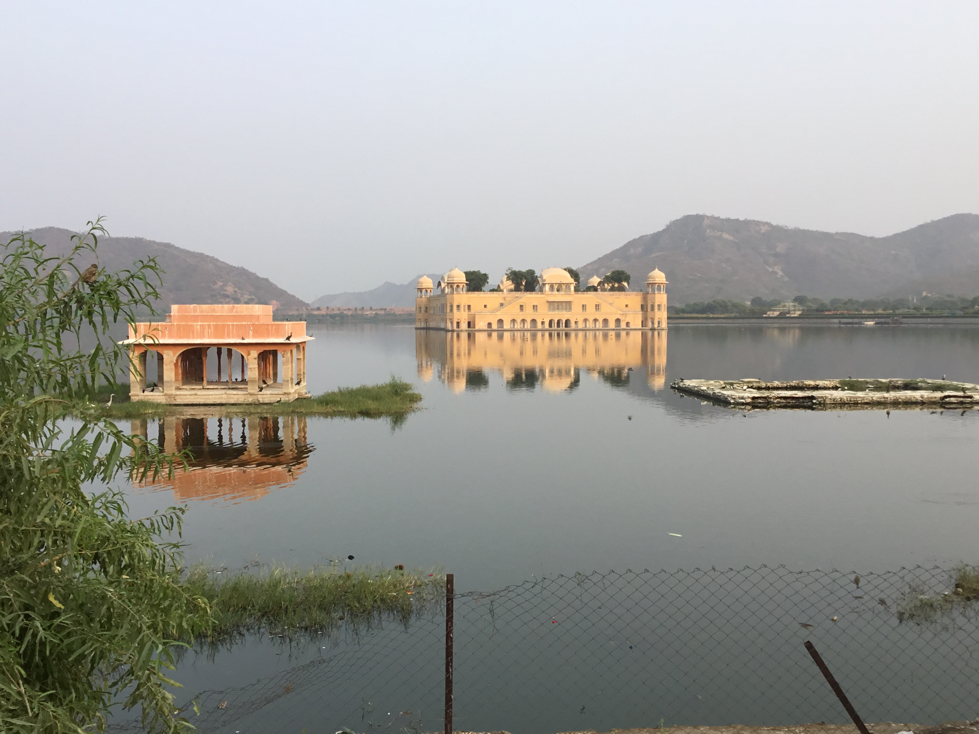
                          On the way back to Jaipur we stopped at Jan Mahal as it name suggest Jan Mahal is a Palace built in the middle of the Man Sugar Lake

                            Jan Mahal shares a special place in the category of amazing architecture ideas in the making of the city of Jaipur.

                            Than to finish of the day it was a visit to a another carpet factory.

The Hawa Mahal 

Entrance to the City Palace 

One of the guards and Len to the Royal Palace 


Len with ceremony guards.


Val with a Royal guardsman.

Inside the Pink Fort.

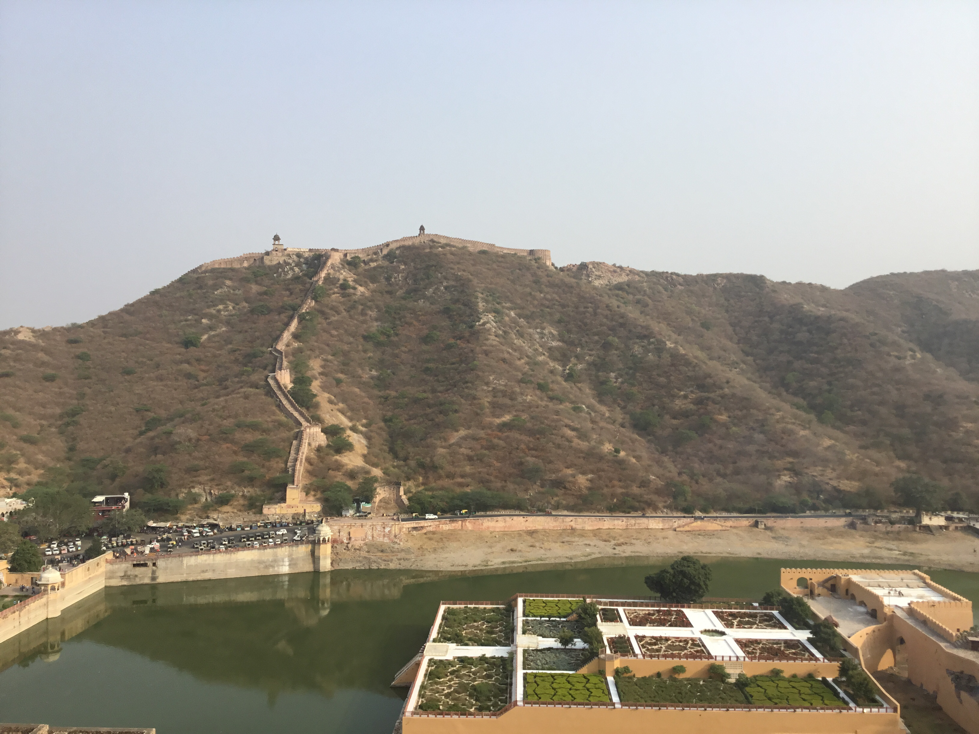
View from the Pink Fort towards Nahargarh Fort.

Inside the Pink Fort.

Jan Mahal which is in the middle of Man Sagar Lake.


Models photo in front of Jan Mahal 

Love 
Len and Val

(Backup) Road to Rajasthan

             Day 10.

             Today was our last chance to on safari in Ranthambhore National park but only 7 of us went, this time we went into sector 5

             We followed the dry creek bed for some 30 minuets when the driver spotted tiger foot prints in the soft dirt on the side of the road 

             Our guide said if they go to the right just up ahead it would be Arrowhead who lives in sector 4, but if they go straight it would be Lightning 

             and our chances of seeing her would be good the footprints went to the right and so did our hopes of seeing a tiger.

            About 2km up the road our guide got the driver to stop he had heard a warning sound from the monkeys we traveled approximately 

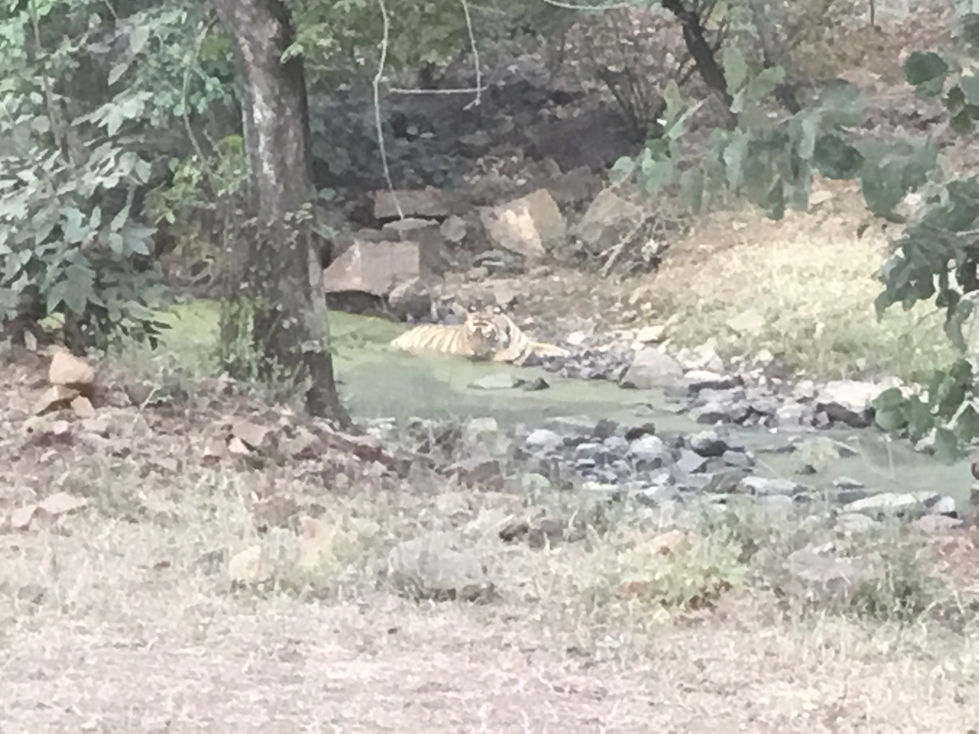
            another 1km and came across a water hole and about 120mts from us was a tiger but not lighting this was a big male walking down

            the the other side of the creek bed towards the waterhole he stopped laying in the water having a drink and giving us five minutes to photograph 

            him from about 100 feet away.

            On the way back the monkeys deer antelope where plentiful and a mongoose were also spotted.

            Back to our hotel at 0930 with breakfast a shower and it was on the road by 1030 for the drive to Jaipur which is known as the Pink City 

            for the colour of the buildings in the old town. Parts of the road are very rough so the 153 Km took 5 hours.

            Jaipur was founded in 1727 as Mughal power within India was declining. The then Maharajah Jai Singh moved his capital from Amer Fort down 

            onto the plain below. The city is now the capital of Rajasthan State.

            Called the Pink City because of the Pink paint on all the buildings in the old city area. This was apparently done to imitate the magnificent,

            Red sandstone buildings of the Mughals and in attempt to impress the Prince of Wales when he visited Jaipur in 1876.

            On arrival check into our hotel had lunch and took a rickshaw ride into the old part of town to view that part of Jaipur from a part of the

           old city wall and then saw how the locals come to sell there goods from villages around Jaipur such as jewellery clothing shoes saris and spices.

The male Tiger in Ranthambhore National Park 

Spotted Deer.

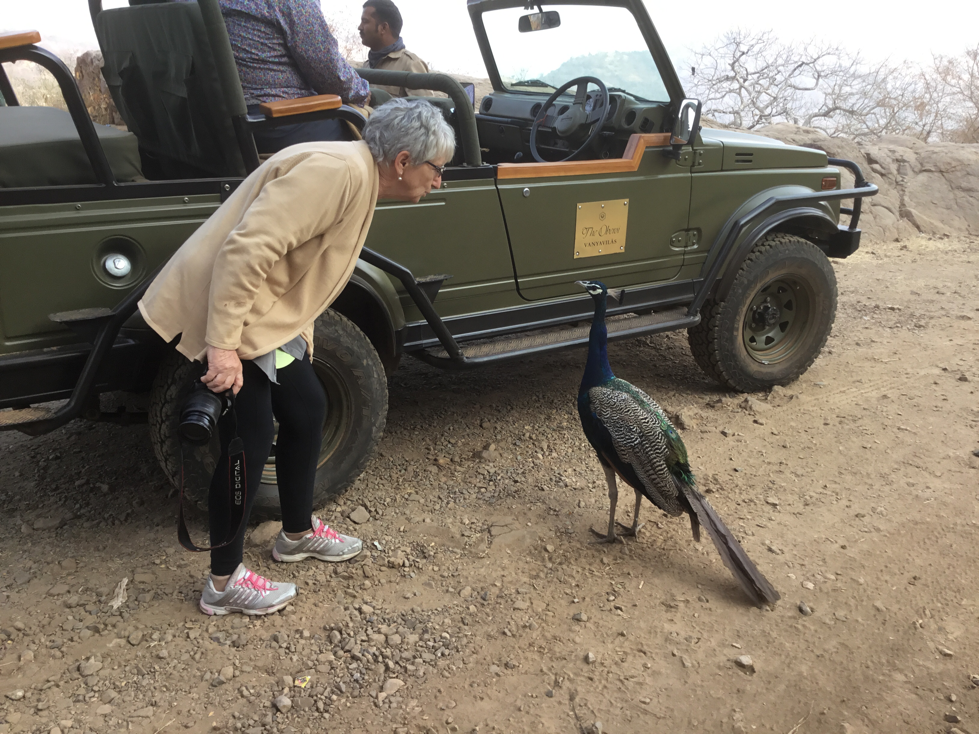
Val making friends with a Peacock.

Monkey watching us.


Our Rickshaw driver.

Traffic in Jaipur.


Building a Metro station in Jaipur without little disruption.

Love

Len and Val

Sunday, 5 November 2017

Road to Rajasthan


              Day 9

              Our first day in Ranthambhore we departed the hotel at 0645 for a safari in the Ranthambhore National Park this is one of the prime examples 

               of project Tiger’s conservation efforts in Rajasthan.

               The forest around Ranthambhore was once the private hunting grounds of the Maharajas of Jaipur and is one of the largest national parks in 

                northern India.

                Ranthambhore National park is renowned for its tiger population the park also have other animals such as Leopard,Nilgal, Wild Boar,

                Samba, Hyena crocodile and Sloth Bear.

                In the morning safari deer monkeys and tigers where seen along with a lot of bird life,back at our hotel around 1000 am for breakfast 

                And a laze around the pool lunch and out for the afternoon safari no tigers but bird life monkeys deer wild boar crocodile and a sloth bear 

               were  all seen

                a great day and a change from not seeing Temples Pagodas and Mahals.
Wild life in the Ranthambhore National Park.

Monkeys in the park.


The local sightseeing taxi in Ranthambhore 


Big buck and the leader of the heard.

Crocodile next to the waterhole.


Sunset over the Ranthambhore National park.

Love 

Len an Val